
Jasper AI
Brand Voice: teaching AI to sound like your company
Brand Voice, Jasper's core feature, needed a revamp. With AI models upgrading constantly, it was time to grow with the capabilities of the newer models. The feature went from a single-file upload to a guided, multi-input experience: one that asked for richer context, showed customers how Jasper transformed that context into a voice, and let them revise the voice before usage.
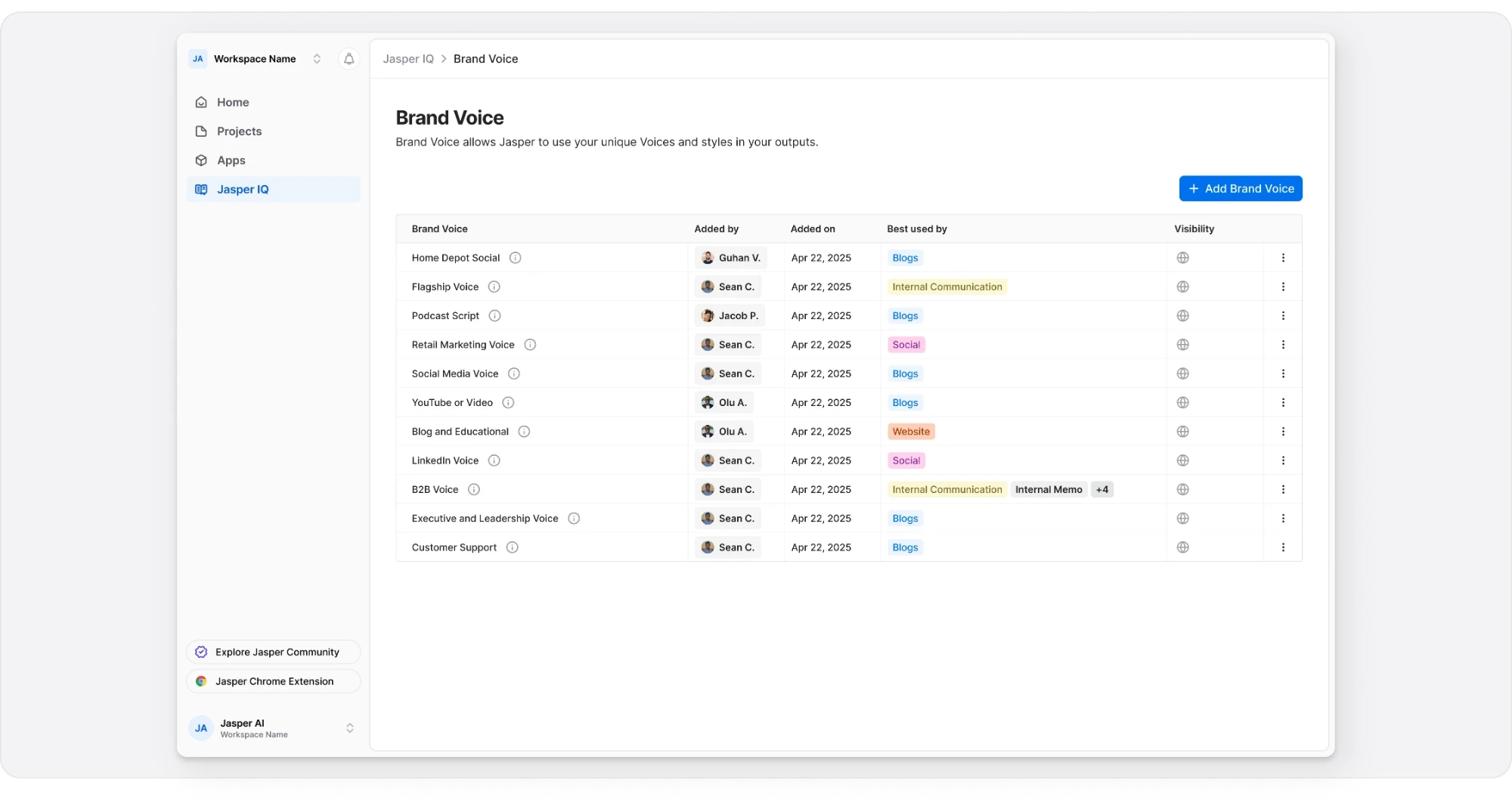
Overview
When I joined Jasper in September 2024, Brand Voice was central to its promise of generating content that sounds like your company. Yet only 17.6% of weekly highly active workspaces used it. Customers were expected to teach Jasper their company’s personality, and they reported that the voices it generated did not sound like their brands.
Over four months Brand Voice was rebuilt around richer inputs, guided creation and real control over the result. It was the first implementation of a reusable creation framework I designed, the same template Jasper IQ is now built on.
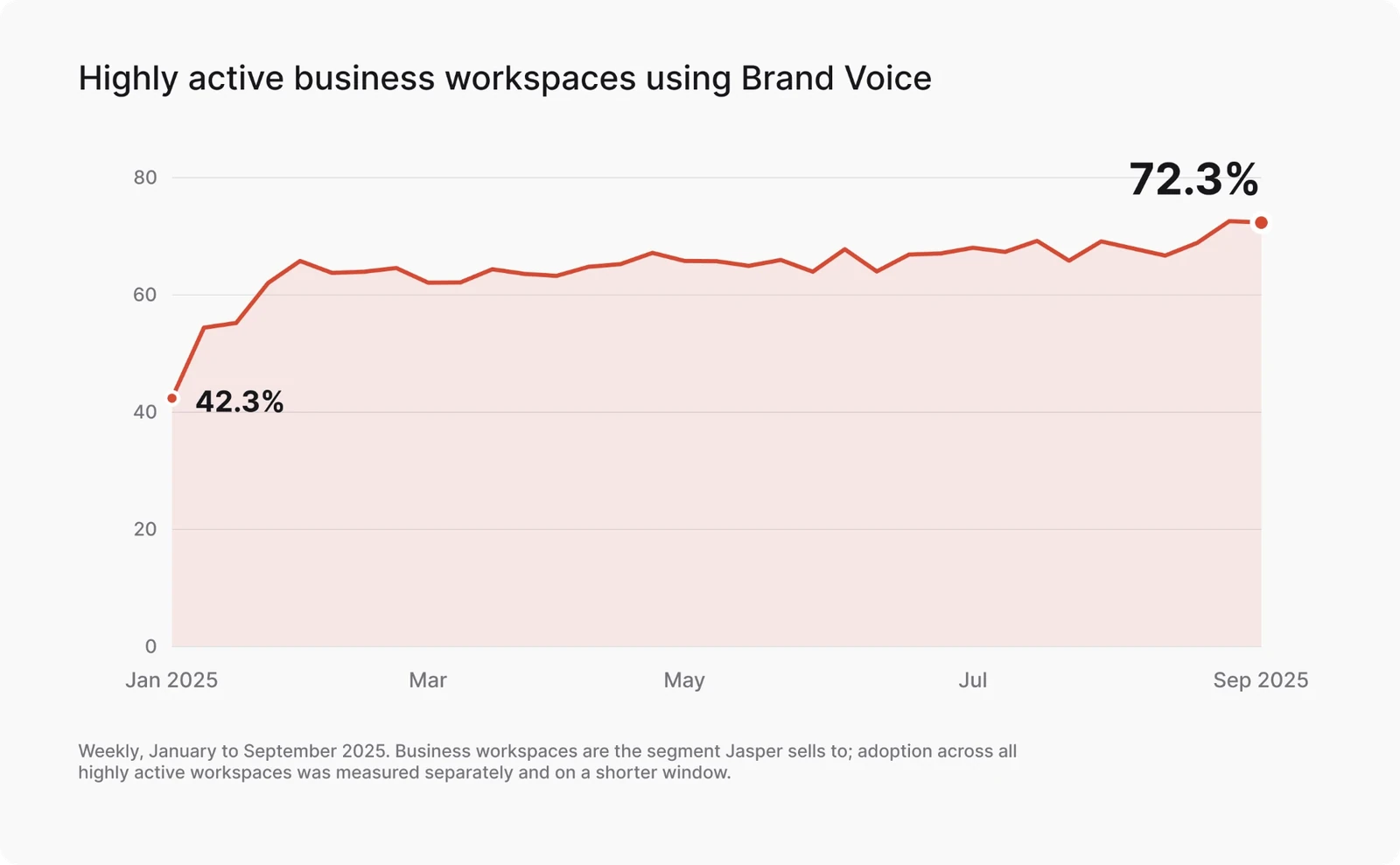
Following launch, adoption among highly active business workspaces rose from 42.3% to 65.7% in four weeks, reaching 72.3% by September 2025.
Role
As a Staff Product Designer working on Jasper’s design system, I helped build Spark from its atomic foundations, including tokens and components, through reusable templates and product experiences.
One of the most rewarding parts of design systems work is connecting those foundations to real business outcomes.
Brand Voice gave me that opportunity. I developed and validated a reusable creation template, then introduced it to other product teams as an established interaction pattern they could build on without starting from scratch.
During my tenure, that framework expanded beyond Brand Voice to Audiences, Knowledge Base and Product IQ.
But we’re here to talk about Brand Voice, so I’ll get off my design system soapbox and show you how the experience came together.
Problem
Let’s start with some context first. There are a few companies we know and love that have a distinct brand voice all of you would recognize. Without the logo, we already know who they are just by the writing style alone. Some brand voices are witty, charismatic, corporate: there is a wide range.
Our job at Jasper was to capture that voice and the wording style behind it, then generate content that stays on brand and on theme across every campaign and marketing asset a customer produces.
Let’s test your brand voice eye.
Which brand’s social team wrote this reply?
 NoName@noname
Wendy’s@Wendys
@McDonalds So you’ll still use frozen beef in MOST of your burgers in ALL of your restaurants? Asking for a friend.
Whose app sends push notifications like this?

😨You’re scaring me… I’m afraid of people who skip their lessons. Do one now!
Whose social team wrote this one?
 NoName@noname
Popeyes@Popeyes
Sounds like someone just ate one of our biscuits. Cause y’all looking thirsty.
1/3
If you got all of those correct, you know your brands and their personalities. That is a brand voice doing its job. The problem comes in when the person who usually writes the copy isn’t available and it is your job to keep the brand voice consistent across multiple areas of the product.
I have actually seen an example of this in the wild. Let’s take a visit to Duolingo’s 404 page. Duolingo’s brand voice guilt-trips its users into completing a lesson. Now take a look at their 404 page. The owl is there, in tears, which is the brand identity. The writing is not, which is the brand voice.
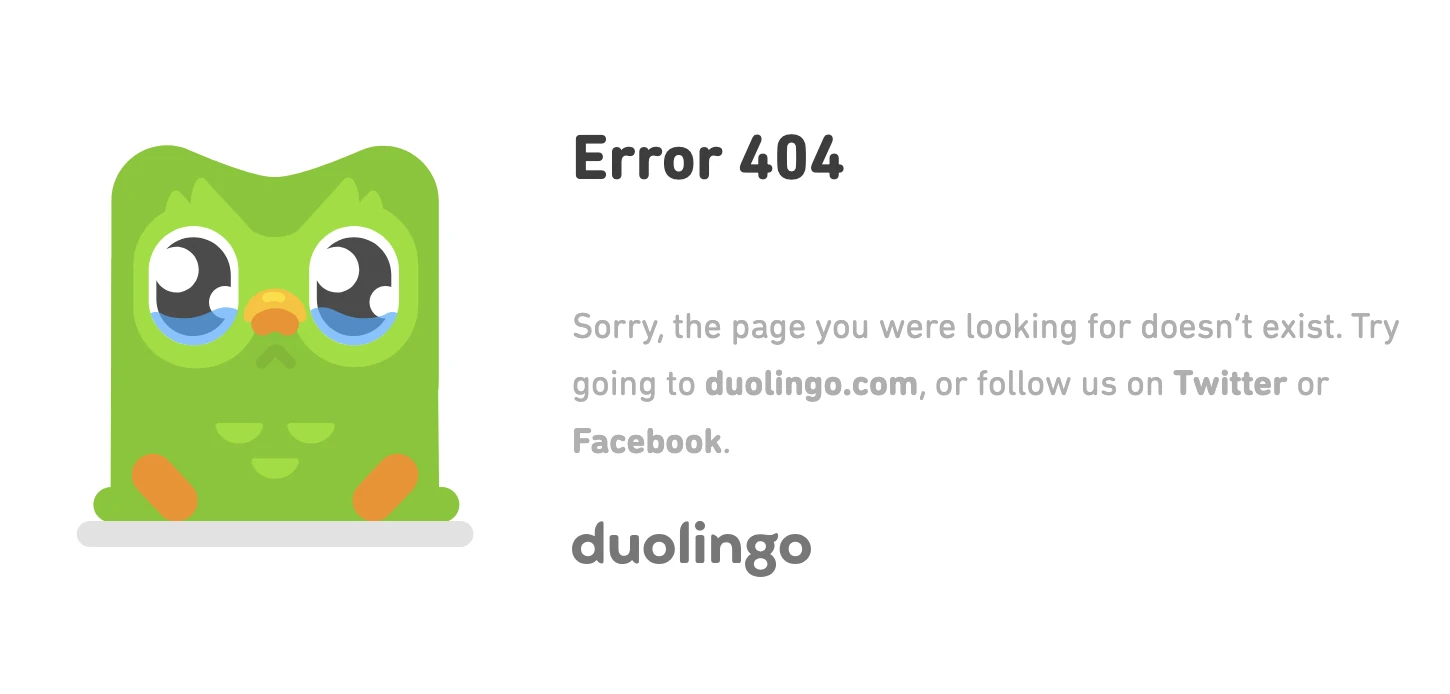
Sorry, the page you were looking for doesn’t exist. That sentence can belong to any company on the internet. The illustration carries the brand and the copy carries none of it.
That gap is what Jasper is designed to solve. A company’s voice should not depend on who happens to be writing: the engineer shipping the 404 page should have the same access to write copy that aligns with the brand standard.
Although Jasper customers loved the promise we were selling, they weren’t able to see the quality of that brand voice reflected in the content generated.
Brand Voice wasn’t delivering the quality customers expected
After each generation, Jasper shows customers a quick survey to tell us whether the output was accurate, with a simple 👍 or 👎. We began to see a decrease in our quality score. As a double confirmation, we began to see an increase in support tickets and customer feedback about the quality of the voice. After extensive research, we narrowed the issue down to two main areas.
- Jasper asked customers to teach us their brand voice through one uploaded file.
- The newer AI models could hold more context and memory, but we hadn’t upgraded the experience.
Back in May 2023 when Brand Voice shipped, one file was the right option for the capabilities of the AI model at that time. By the time I arrived those context windows had grown roughly thirtyfold and the field had not moved. The problem surfaced as quality, however, three things were missing:
- Varied context. There is range to a company’s brand voice. Uploading one file cannot accurately teach that range.
- Feedback. Are we giving customers enough feedback to know when they have given us enough context to work with?
- Control. Customers needed a way to inspect, preview and adjust the voice after it was generated. Jasper can try its best to be accurate, but it will not be perfect.
So, the customers created a workaround.
The customer workaround
Since only one file was allowed, customers pasted multiple examples into one long document to force more context through the single upload field. Our own support team wrote tutorials teaching the hack.
The workaround seemed to work for some customers, but not all. Since I was new to the AI world, I decided to learn a bit more about LLMs. I pulled up as many YouTube videos and journal articles as I could on context windows, how LLMs read context, and RAG systems.
Starting from the design could only take me so far, so I decided to start from the outcome instead: if a customer wants a voice that generates high quality content, how do I build the experience so that happens by design rather than by effort?
Learning how LLMs read context
First, I wanted to know whether more context genuinely produces better content generation.
Finding 1: Including examples helps AI recognize patterns. Research on learning from examples showed that language models can adapt their responses based on samples they are shown, which supported the decision to collect several writing samples during creation rather than one.
Finding 2: More information isn’t always better. Research on long inputs found that AI can struggle to use important information buried in a long document, particularly toward the middle. Customers were already combining writing samples into one file, potentially making some of their examples harder for Jasper to use.
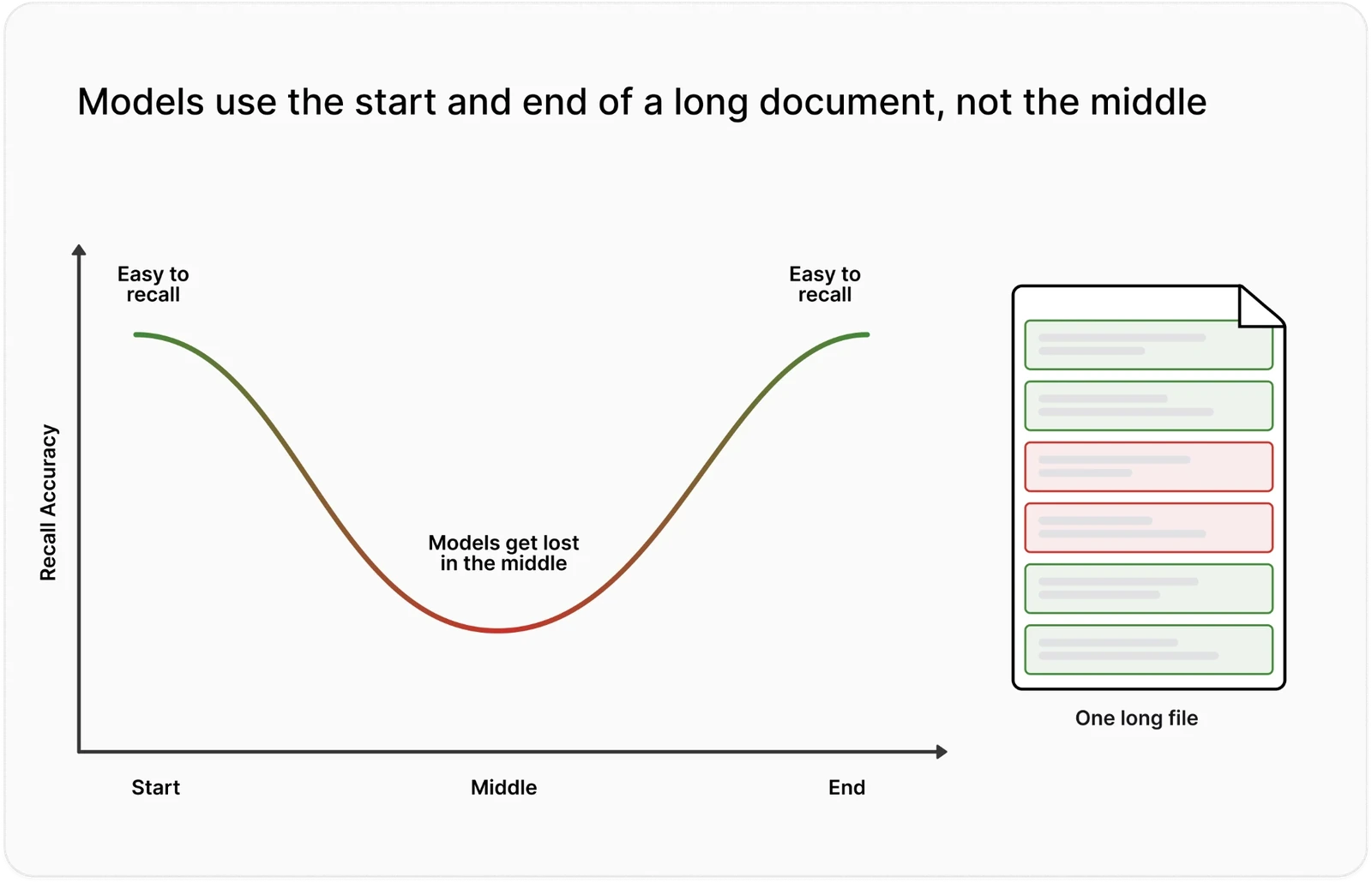
The Challenge
The customer workaround revealed a need for richer context, but the research challenged how we were collecting it.
How might we help customers teach AI their brand’s voice without requiring them to understand how the model interprets information?
Customers shouldn’t need a PhD in AI, or even a full understanding of how best to train it. Our customers should be able to learn by design.
Before we move to the solution, familiarize yourself with the original experience:
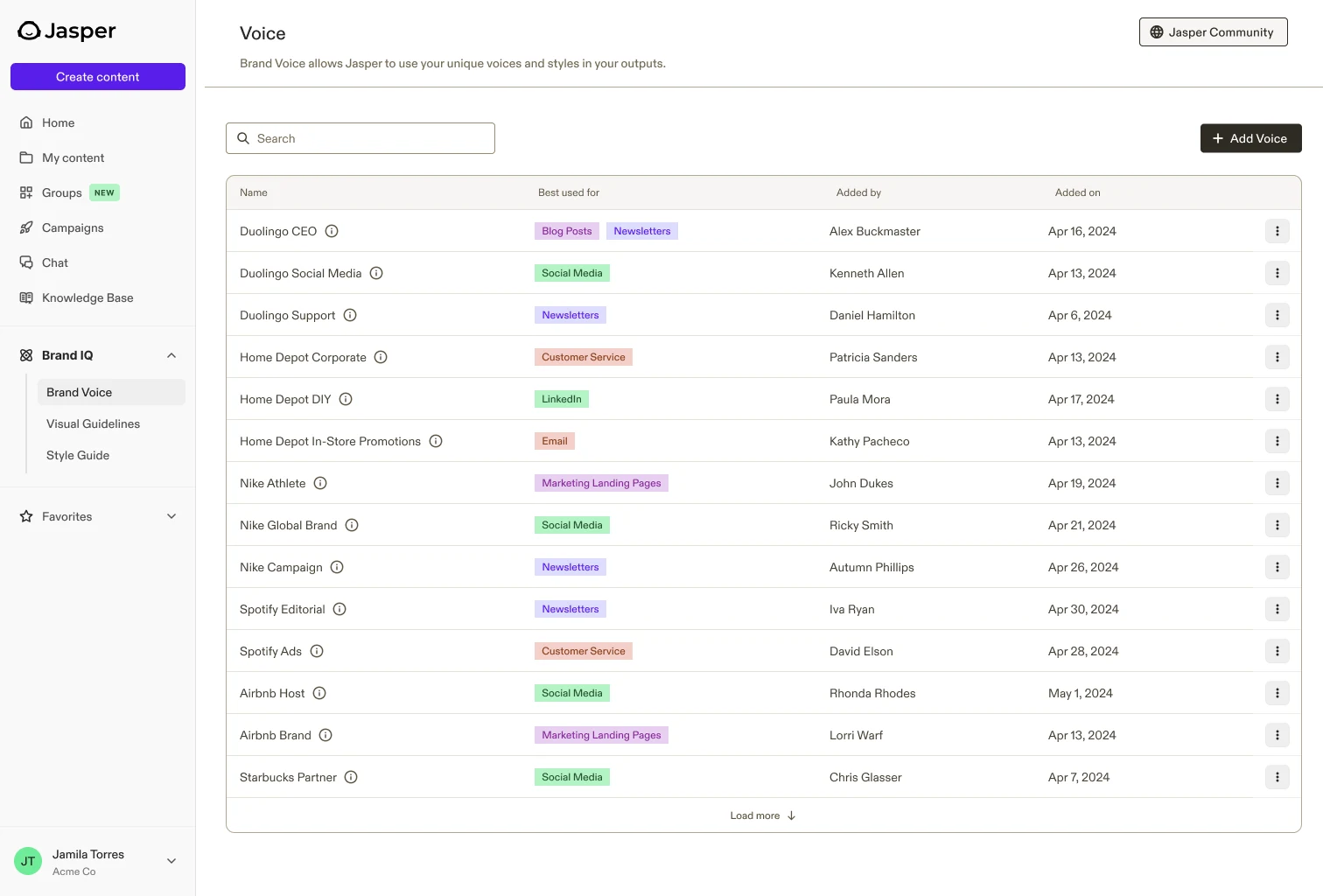
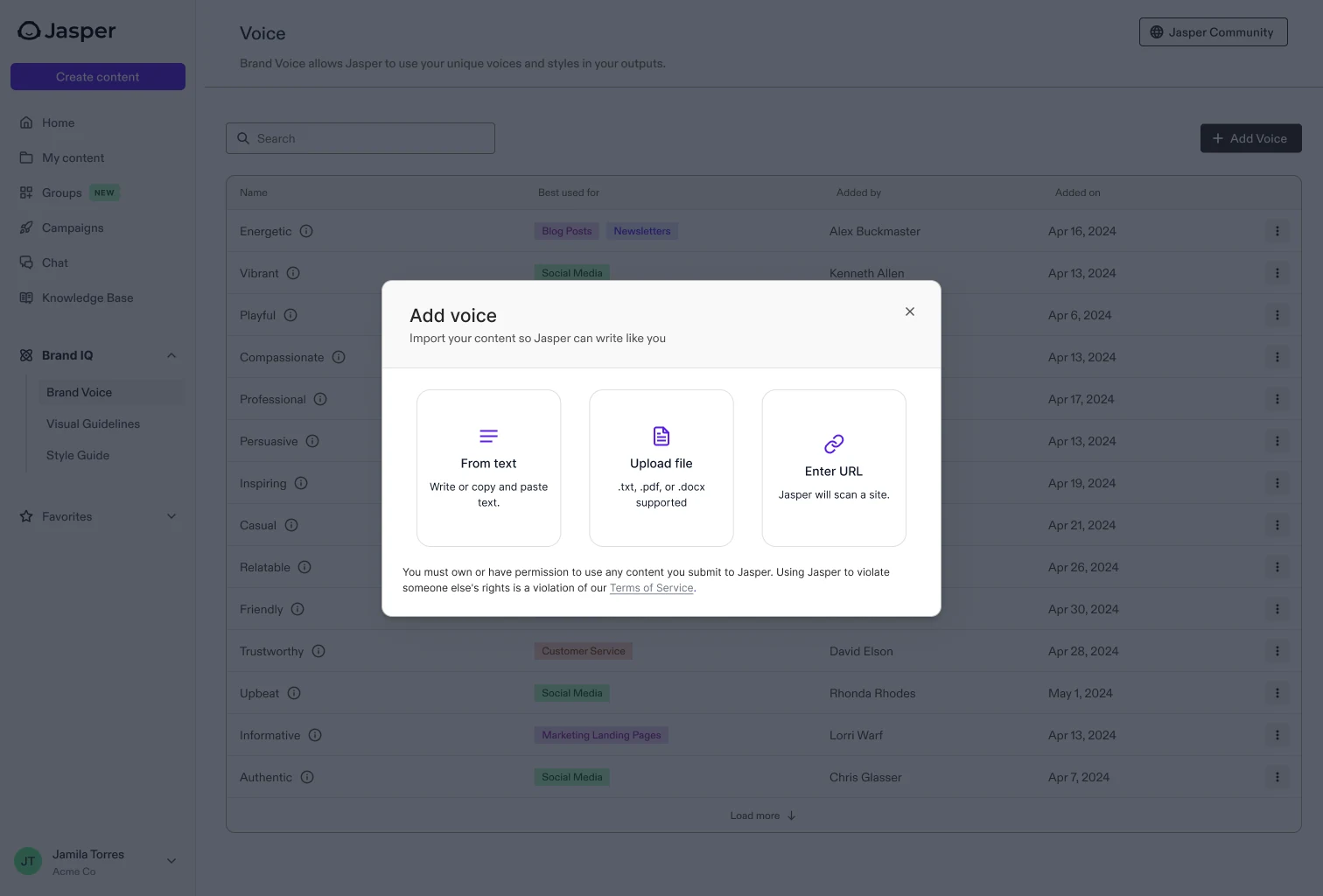
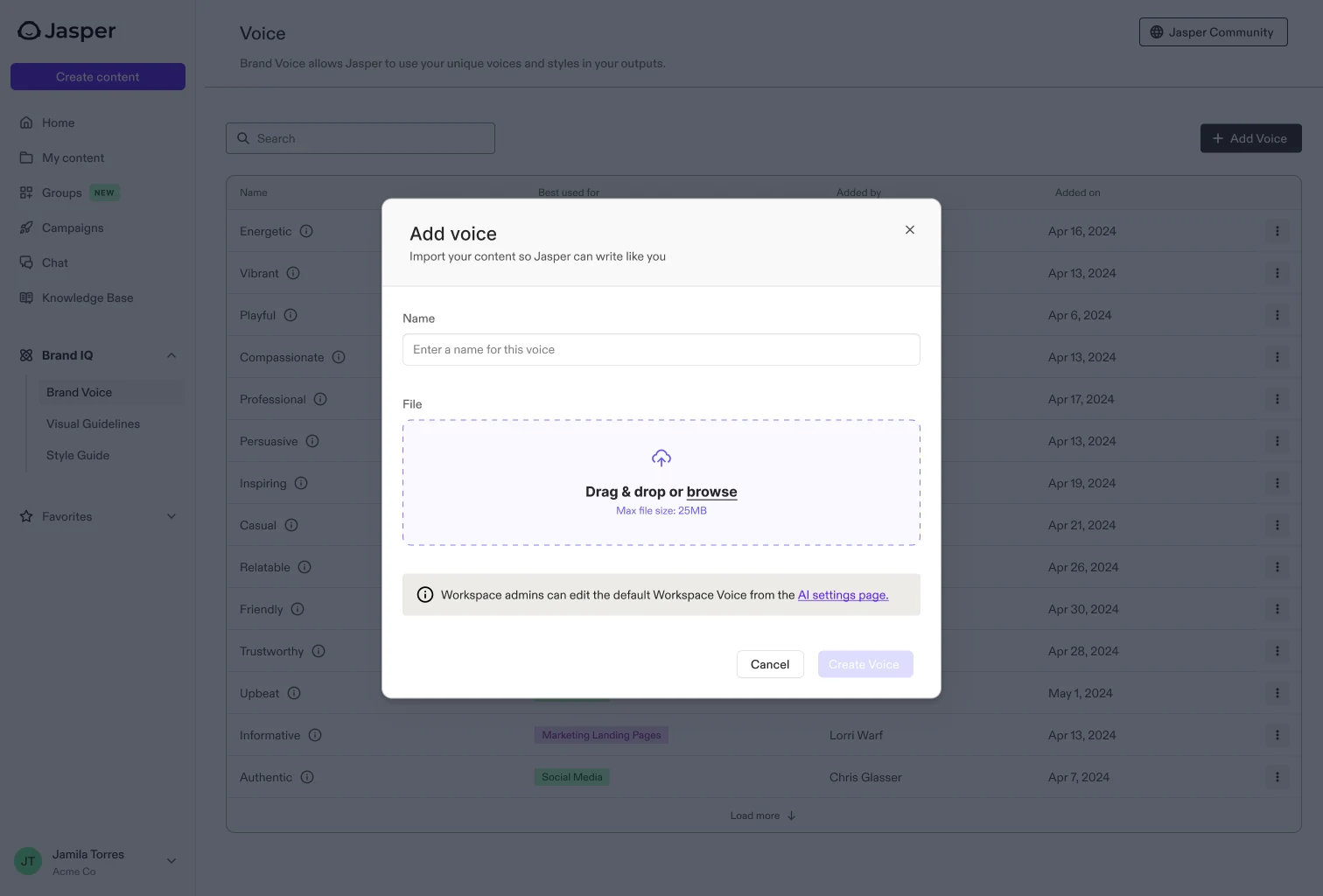
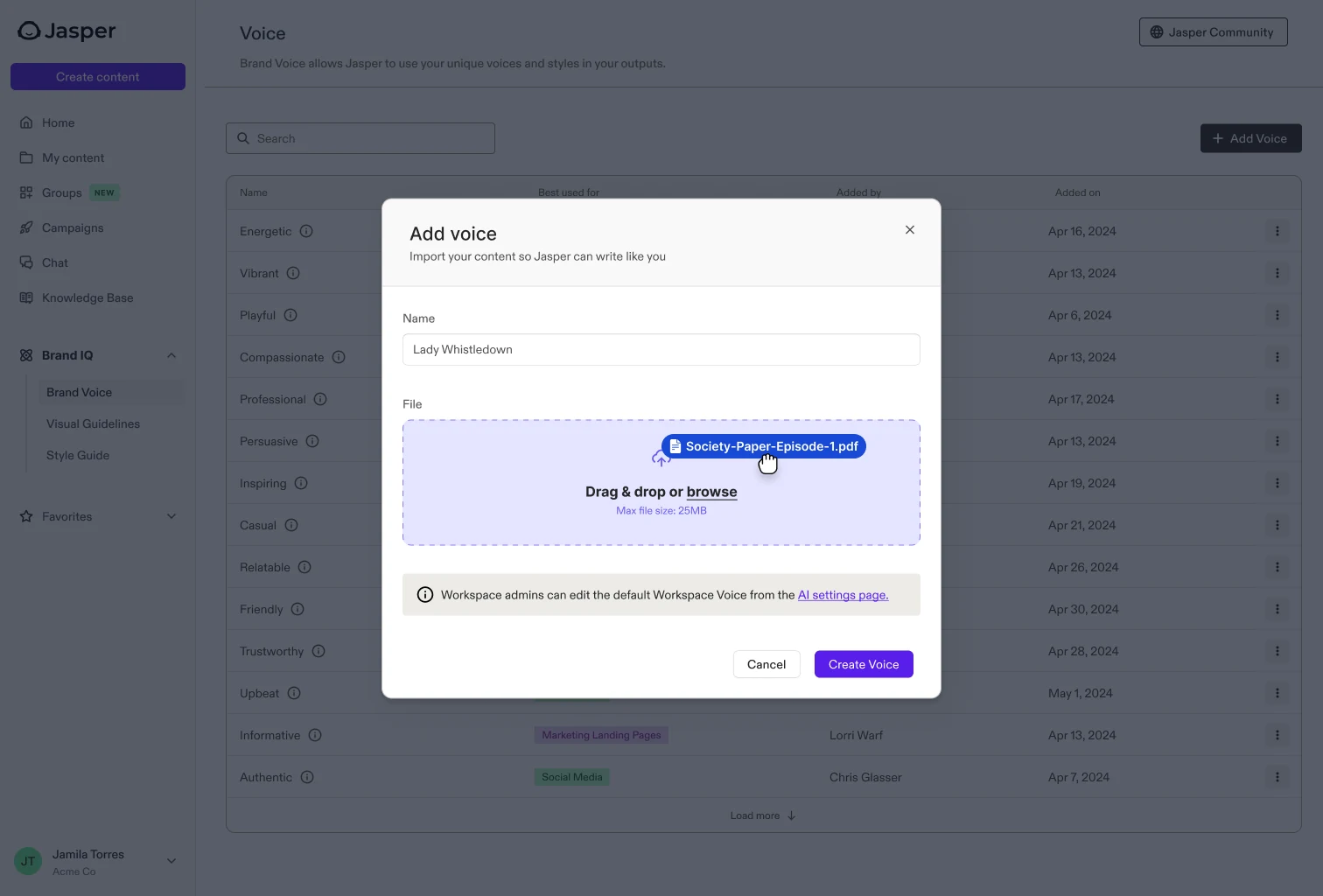
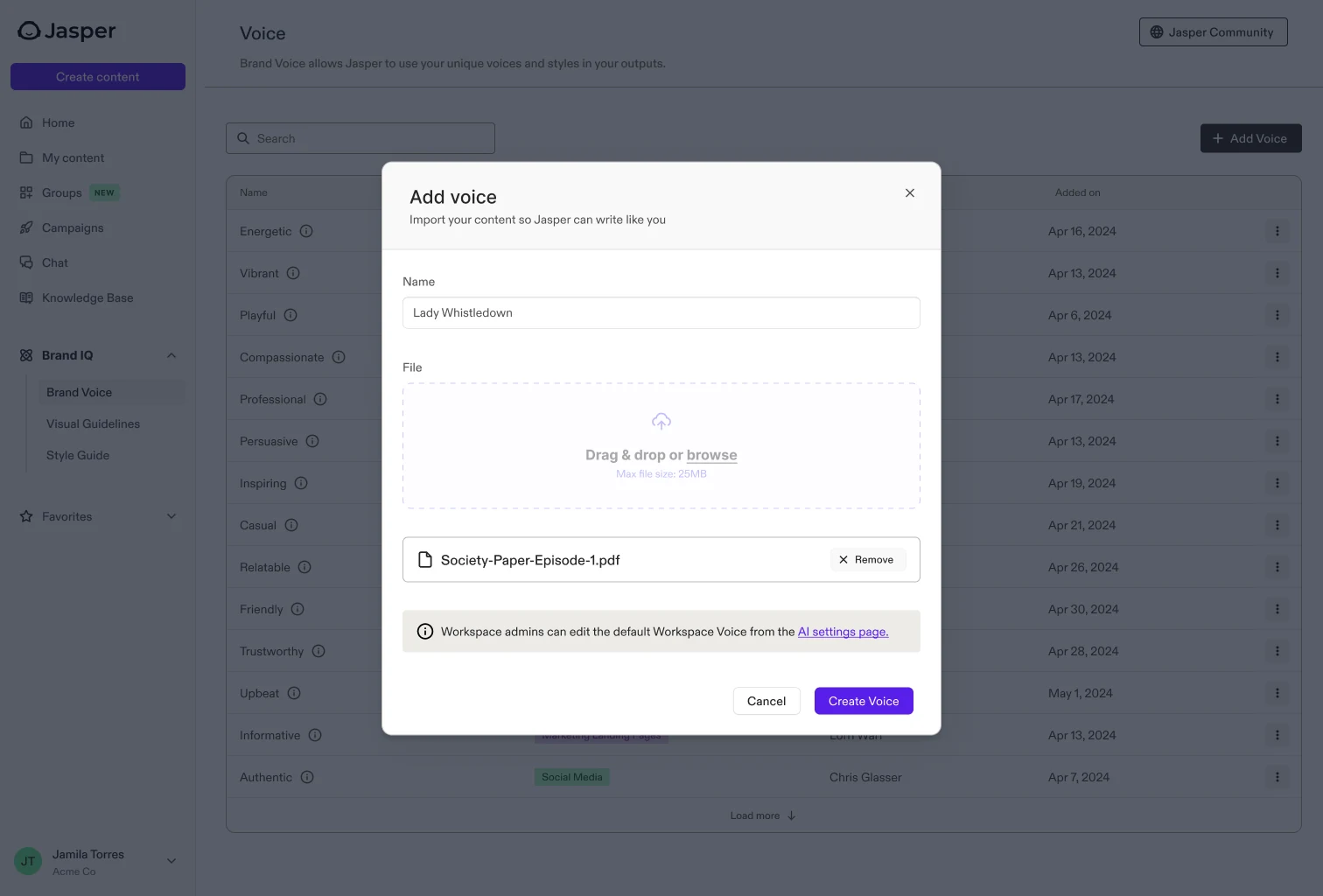
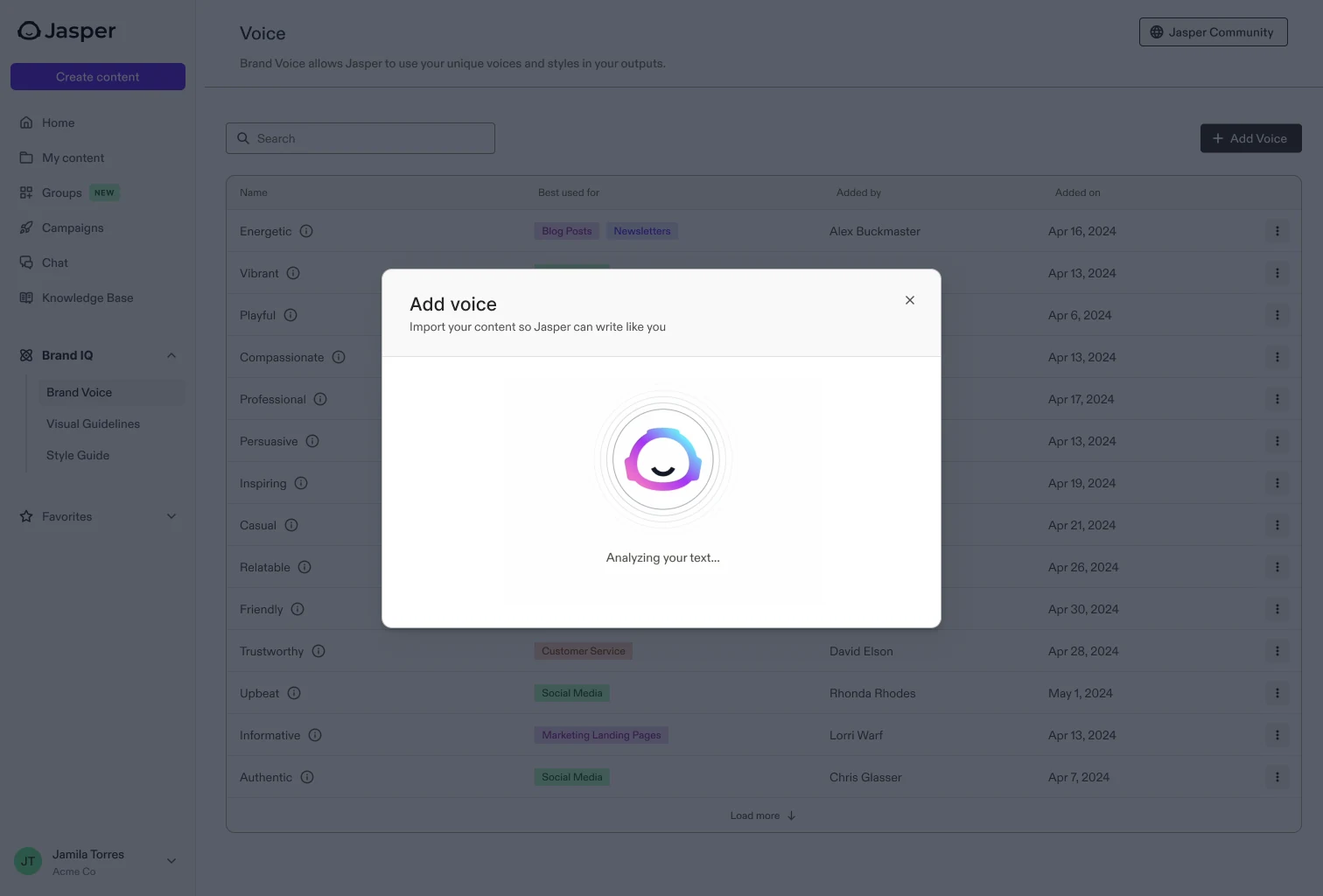
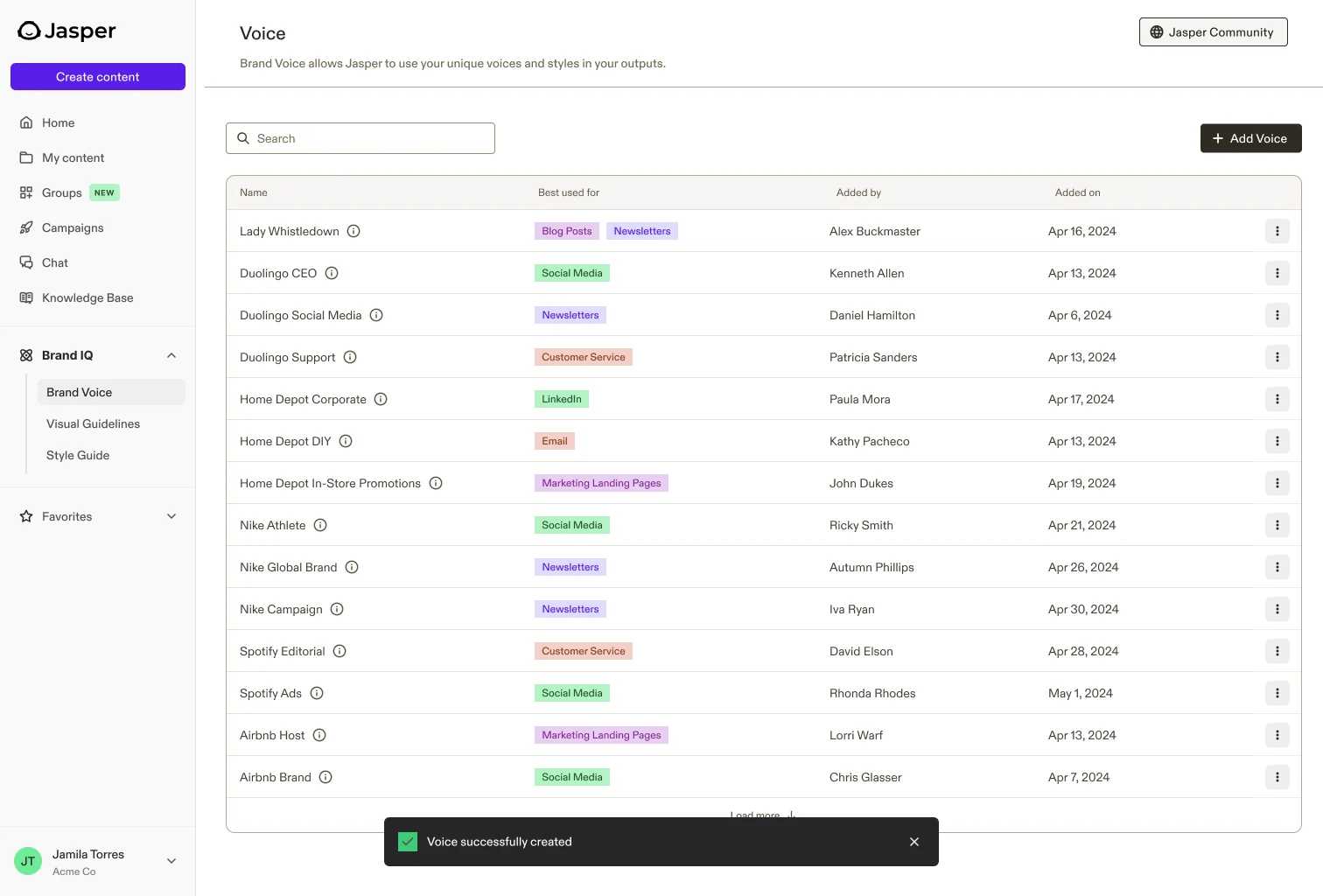
1The voice list. Everything a workspace has taught Jasper, and what each one is best used for.
The Solution
First, make applying the voice seamless
Our customers told us two things:
- They simply forgot to attach a voice before generating.
- Admins wanted to set at least one Brand Voice as a default for the workspace, to keep everyone in that workspace consistent.
First order of business, the lowest hanging fruit, was giving admins a workspace default for brand voice, so adding the voice can be automatic.
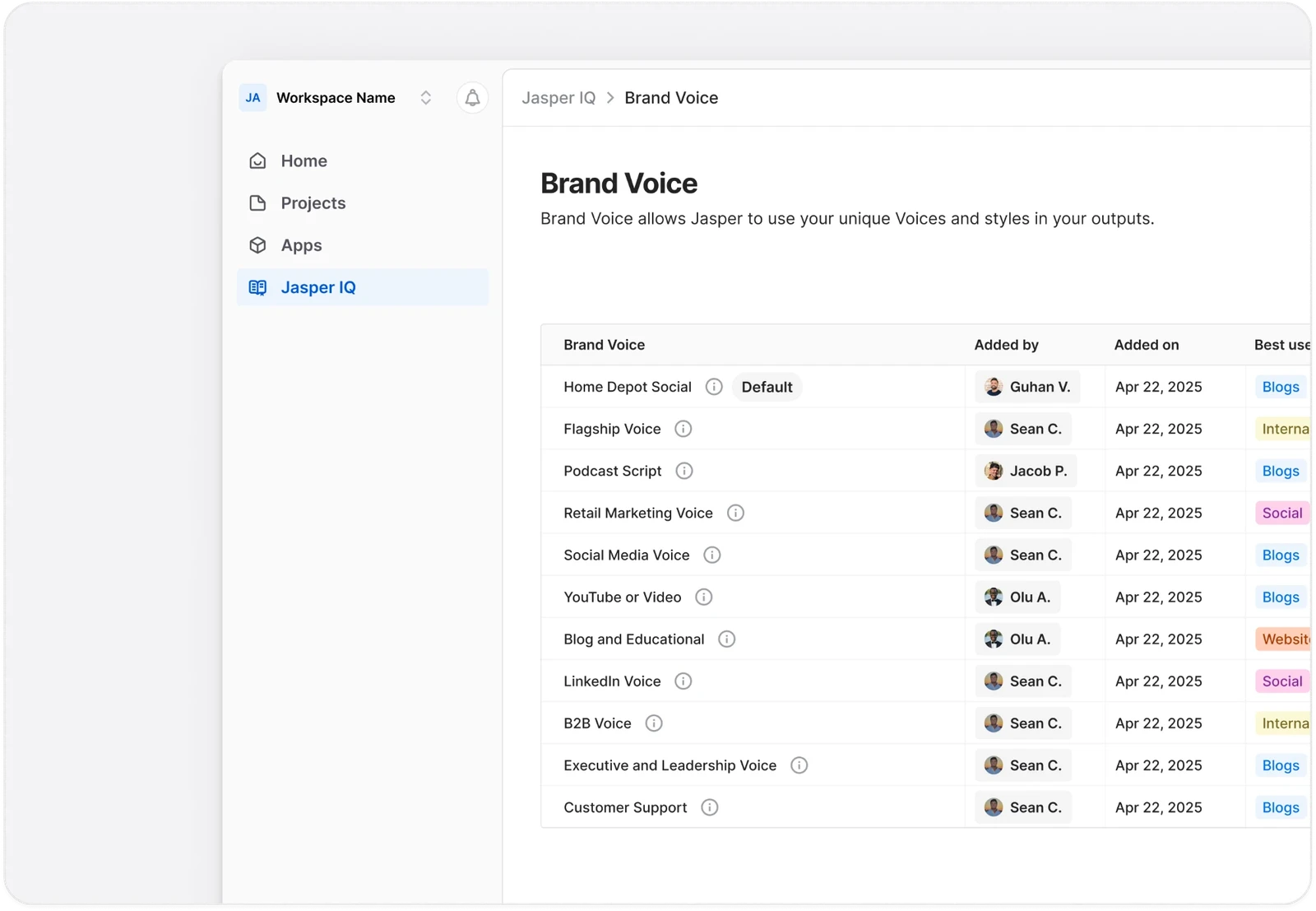
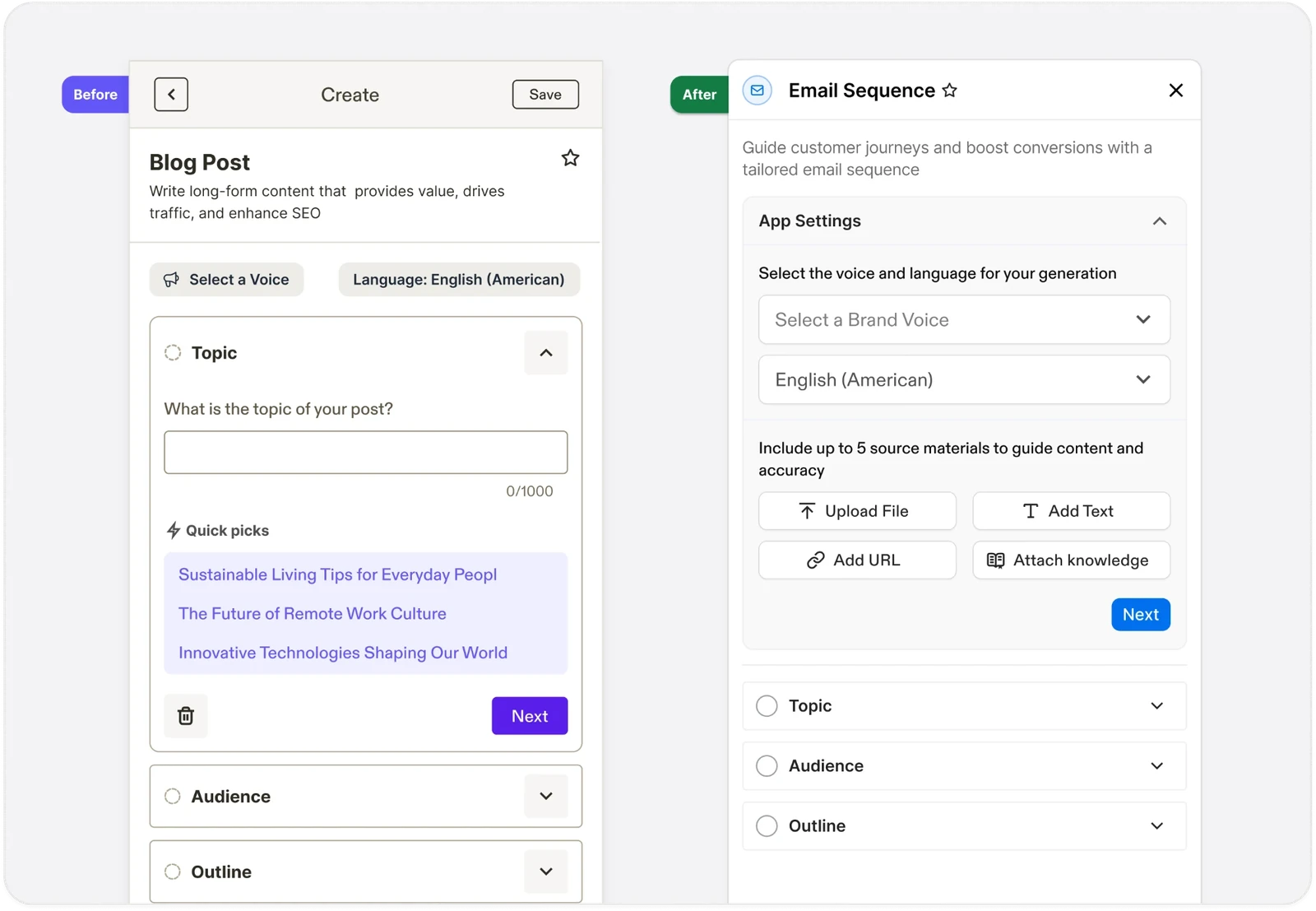
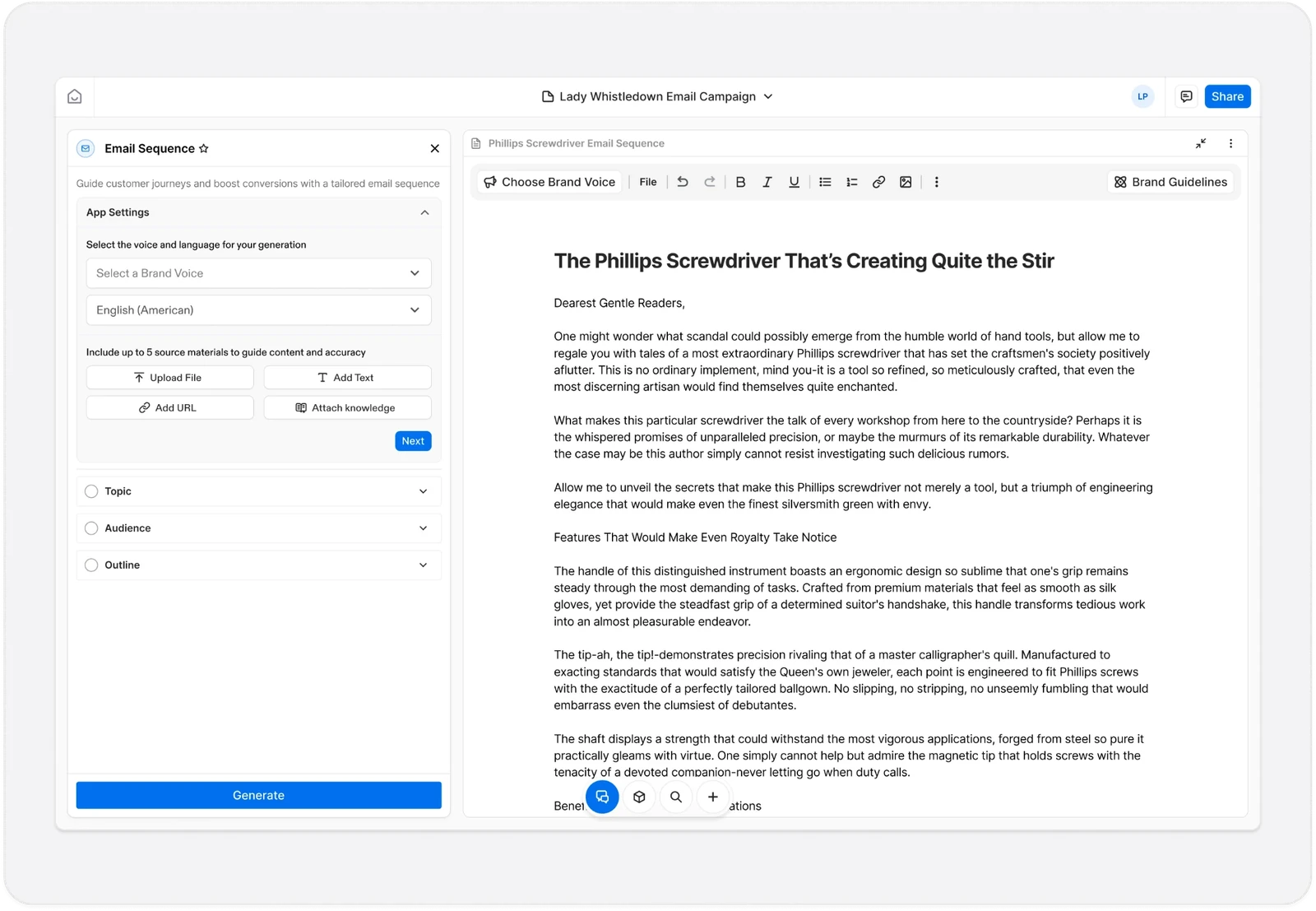
For the generation moment itself, each content app was given a dedicated App Settings section that opens first: the voice, the language, and up to five source materials, settled before anyone types a topic.
Then, make the voice worth applying
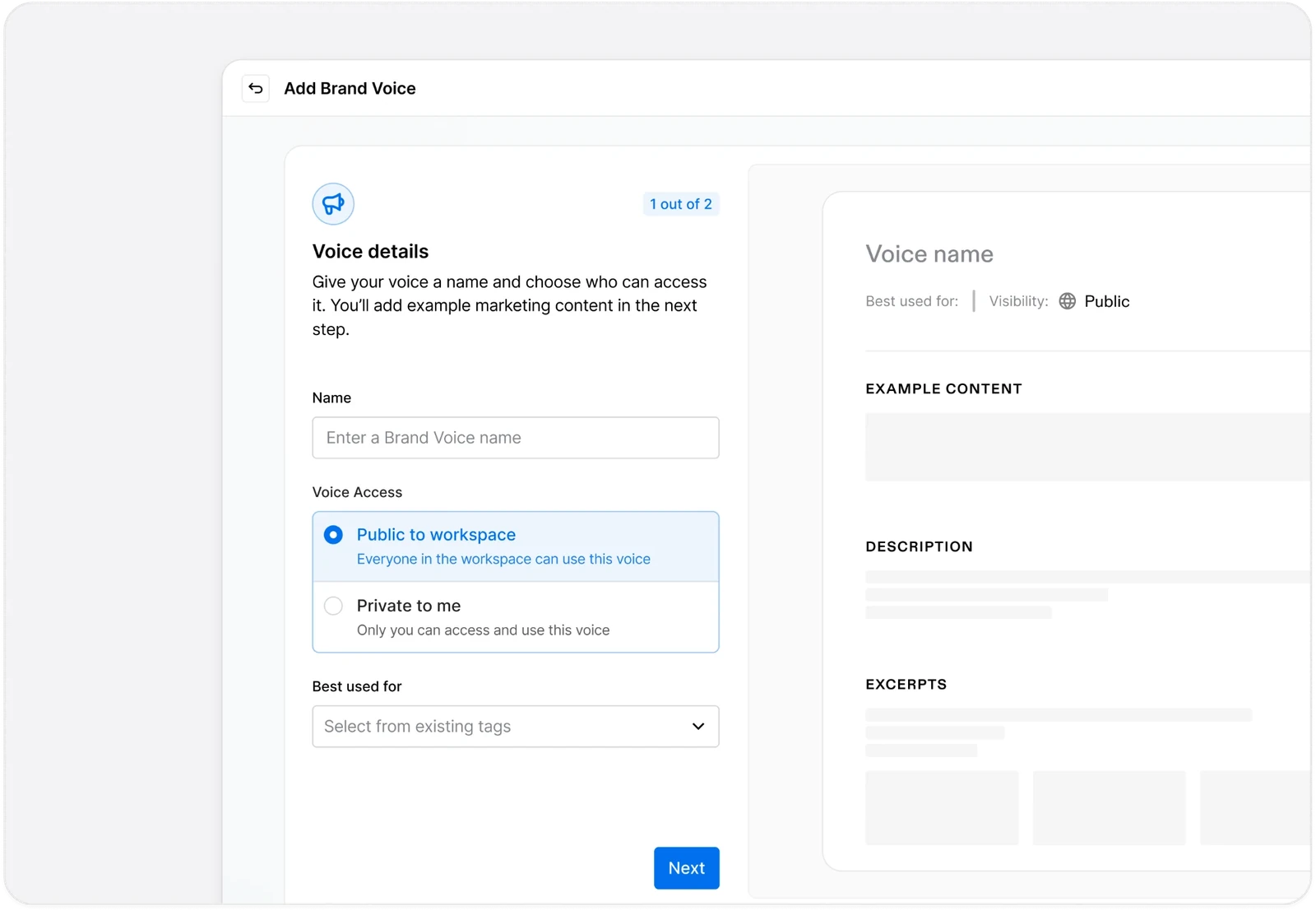
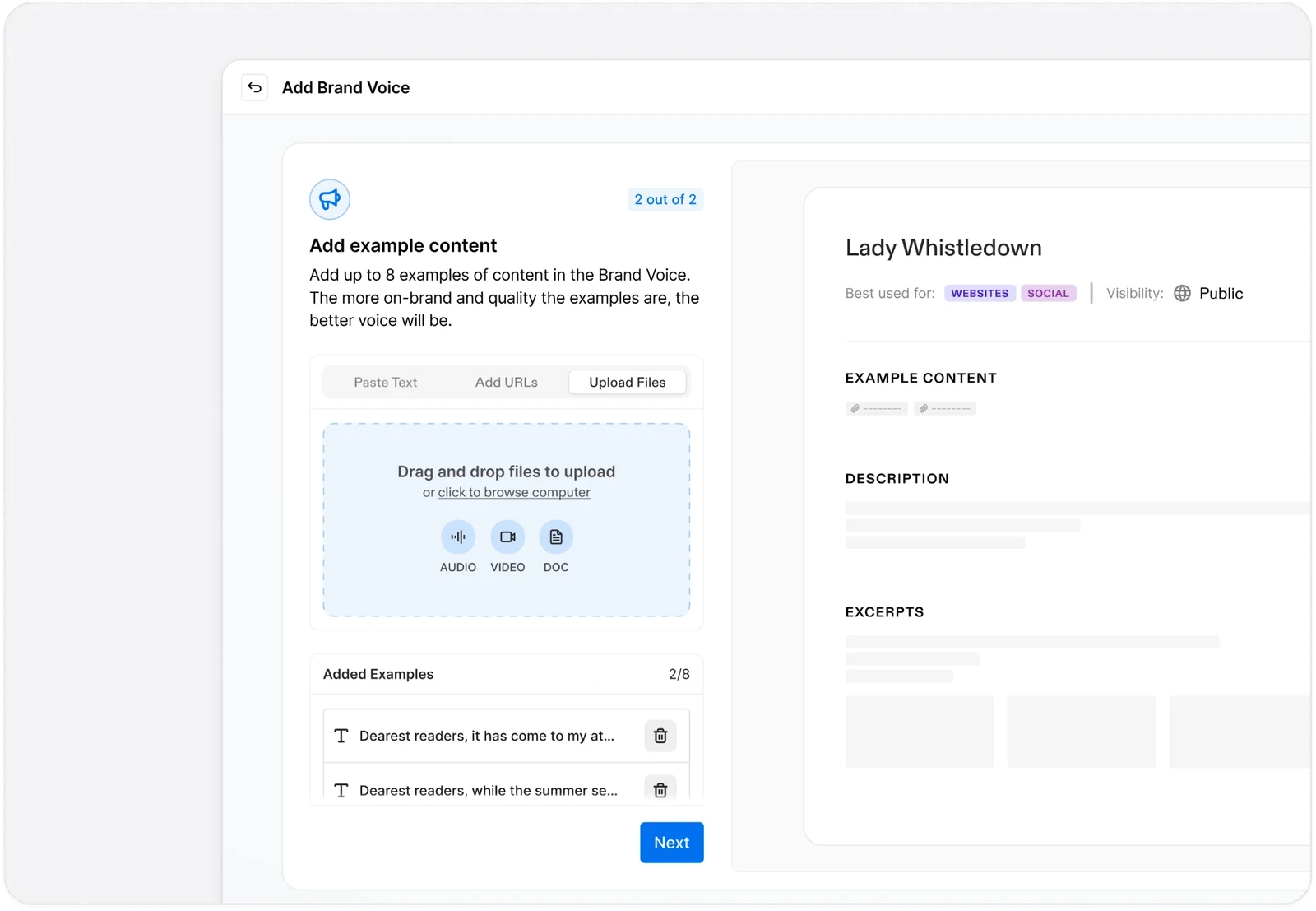
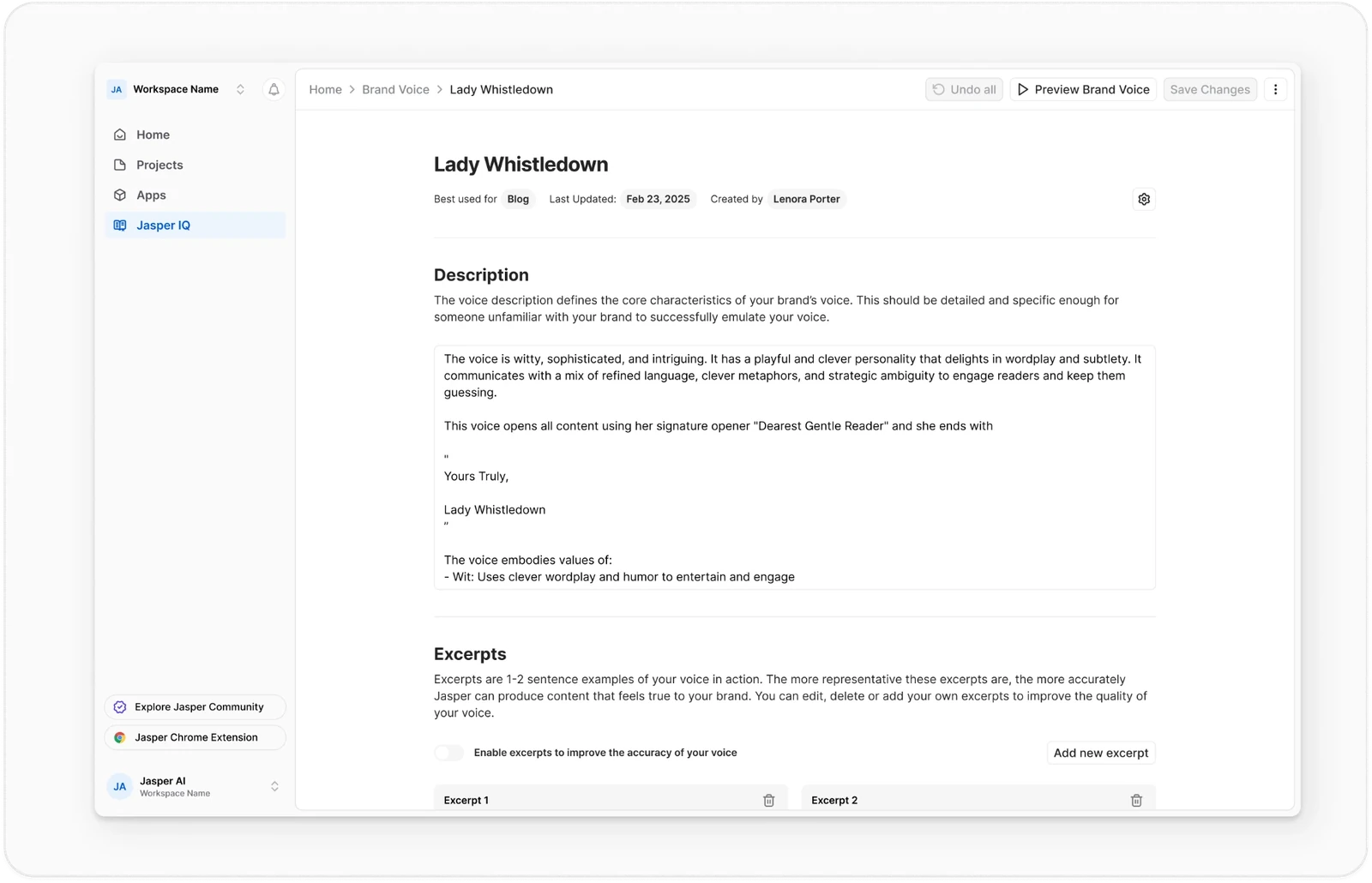
I broke it into four moves: define the voice, add example content, review what Jasper understood, then preview it before committing. The first two are the creation modal itself and the last two happen on the Brand Voice detail page.
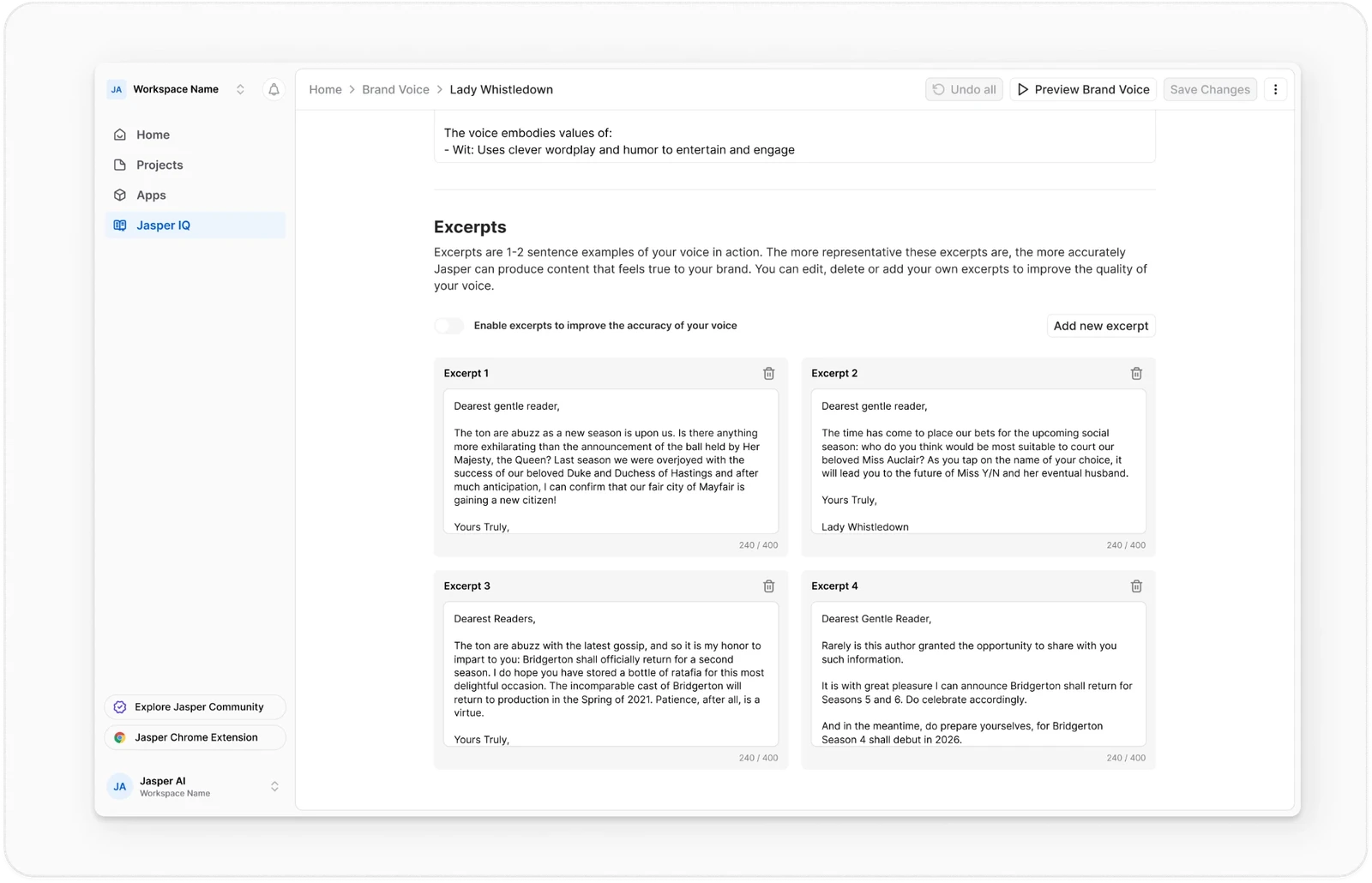
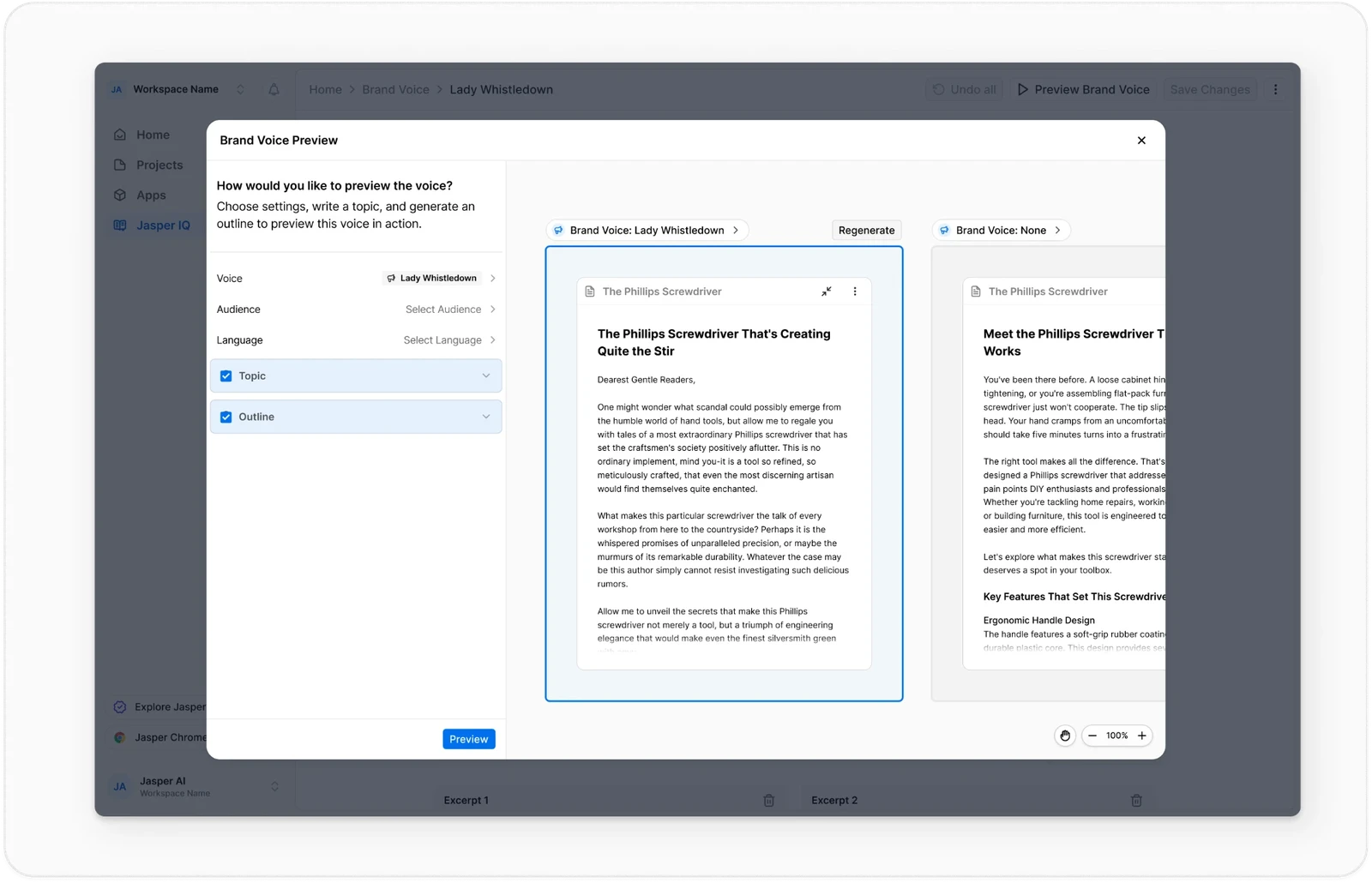
Step three: review the result and adjust. Customers could review Jasper’s interpretation, edit the voice description, and refine the examples used to guide future generations. They could read the written description, or preview the voice in action.
Designing beyond Brand Voice
Brand Voice was the first implementation of a reusable creation framework I developed for Jasper’s intelligence products. Rather than letting each product invent its own creation experience, I established shared interaction patterns that could adapt to different kinds of customer context: how sources are collected, how inputs validate as they land, how steps are navigated, and how a generated result is reviewed before it is saved.
Audiences was the first real test of that, because it takes different source material and produces a customer model rather than a writing style. If the pattern were only skin deep, that is where the seams would have shown. I carried it into Knowledge Base next. Product IQ then shipped on it without me, built by another designer.
See how the framework was adapted in the Audiences case study.
Launch
The new creation flow shipped on February 6, 2025, announced in Jasper’s product updates: the stepped modal, eight context sources, and prevalidation of URLs.
Impact & Learnings
Sometimes the simplest changes address the most immediate customer problems.
Workspace defaults and dedicated App Settings made Brand Voice easier to apply during content generation. The larger creation redesign followed in February 2025.
Among highly active business workspaces, adoption rose from 42.3% in late January to 65.7% by early March, eventually reaching 72.3% by September 2025.
The experience reinforced the value of addressing immediate usability problems while investing in improvements that could scale across the product.
Conclusion
Brand Voice asked customers to teach Jasper how their company communicated but offered only one source to do it. Customers created their own workarounds because the experience hadn’t kept pace with what the technology could support.
The solution wasn’t simply asking for more information. It was designing an experience that helped customers provide better context, understand what Jasper generated, and refine the result without needing to understand how an AI model works.
The principle I took from this project: the quality of an AI experience depends not only on the model, but on how effectively the product helps customers communicate what matters and maintain control over the result.
Other projects

